
Name-Based Case Searches
The Plaquemines Parish Clerk of Court sends online users to Plaquemines Cott eSearch. Guest access there is free. But the portal says so itself. No civil or criminal docket information and no images. The guest screen also hides the party-name search form and its fields. So a surname or a full case style alone may not get you far.
Treat a name as a starting point, not a guarantee. Every spelling, party role, and case type may not surface in guest view. The portal's instructions put civil and criminal docket history behind a paid subscriber account. When the free index runs dry, the better move is to contact the right clerk department. Bring the name and the record type. Add an approximate date and any division or case number you have.
- Open the Plaquemines Cott login page and review the Certified Dates link first.
- Use guest access only for the index-level research the portal allows without charge.
- If the record is not available through that access level, retain the name, record type, date, and any division information for the clerk.
- Request the case-specific docket or an official copy through the clerk when it is needed.
Note: The public login page does not show a guest-facing party-name search field or any matching rule.
Plaquemines Parish Docket Search Login
Cott eSearch is the local access point for Plaquemines Parish, not a statewide database. The login screen offers a User ID and Password for named sign-in. Guests get their own sign-in. A password reminder and account creation are there too. So are site requirements and Certified Dates. Both named-login fields are required, and the password is case-sensitive. Those are the controls the page actually shows. It does not show civil or criminal search filters, so don't assume any exist.
The Plaquemines Cott eSearch login page presents the official access gateway for this Plaquemines Parish docket search.
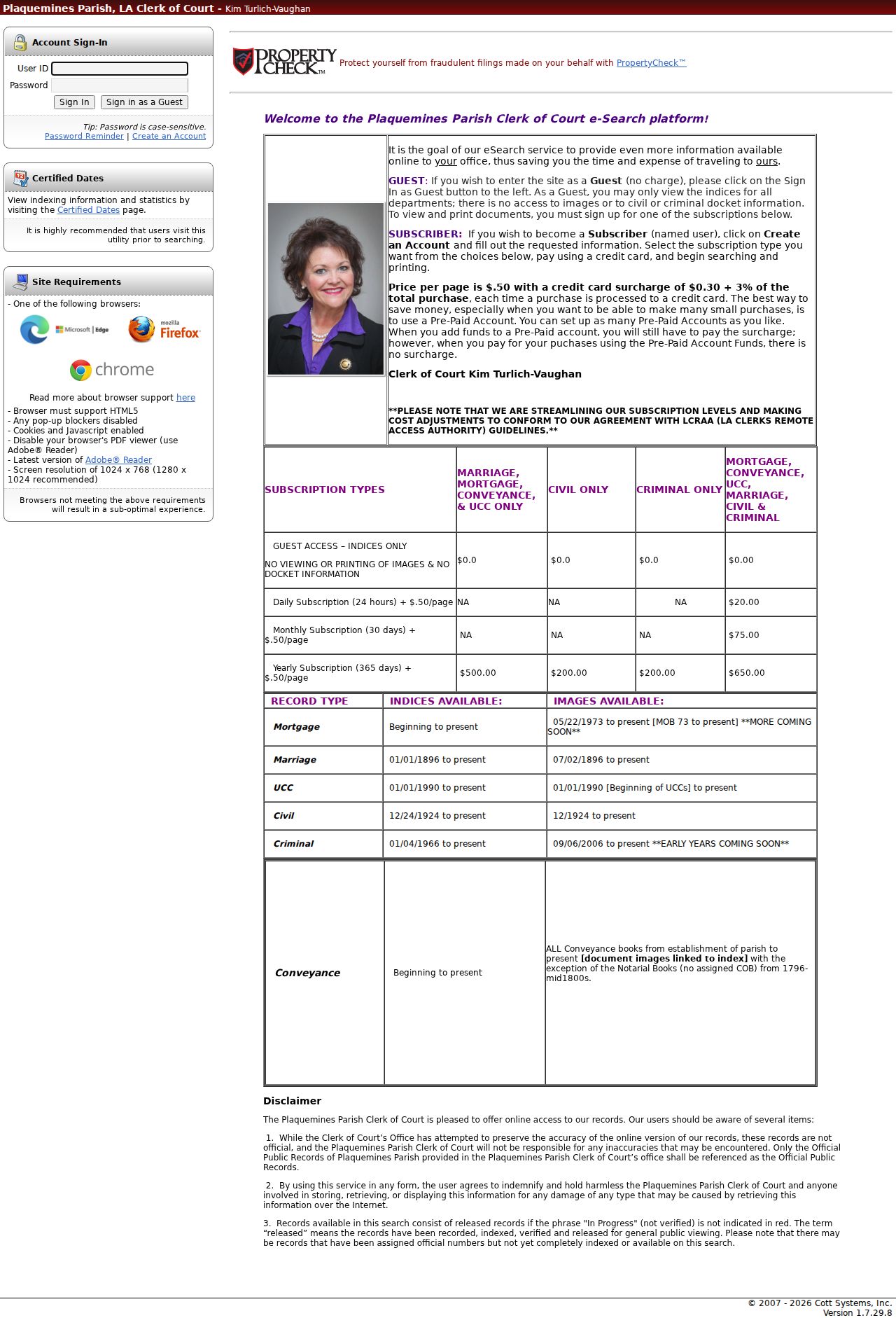
That gateway is just the door. The clerk's records remain the official source for a certified or complete court record.
| Observed surface | Control | Type | Local access note |
|---|---|---|---|
| Cott login | User ID | Text, required | Named account sign-in |
| Cott login | Password | Password text, required | Case-sensitive account credential |
| Cott login | Sign In as Guest | Button or link | Free index-only access |
| Cott login | Create an Account | Link or button | Subscription registration route |
| Certified Dates | Index From / Thru | Date display | Availability utility, not a user query field |
Case Number Searches
Use the exact case or docket number. Pull it from a clerk result, notice, summons, citation, prior order, or minute entry. The local rules mention docket number, docket book, record jacket, and division. But the guest-readable search form publishes no official Plaquemines Parish case-number format. Never build a number from a guessed year prefix, case-type letters, or sequence pattern. Ask the clerk or read the record itself.
A known number also keeps records straight. It separates a parish court file from a sheriff citation record, a justice-of-the-peace docket, or a federal case. The Eastern District of Louisiana publishes its own federal format, O:YY-TY-#####-INI-RIN. That format is not a 25th JDC format. A Plaquemines Parish docket search should never treat a federal identifier as proof of a parish court file.
Plaquemines Parish Docket Search Dates
Check the clerk's Certified Dates utility before hunting an older matter online. It shows which date ranges the index covers, and those ranges shift over time. The civil index begins December 24, 1924. The criminal index begins January 4, 1966. An index range promises nothing more. It does not guarantee an image. Nor does it promise docket history or a full document under your account level.
The official Cott Certified Dates page lists the coverage periods for this Plaquemines Parish docket search.
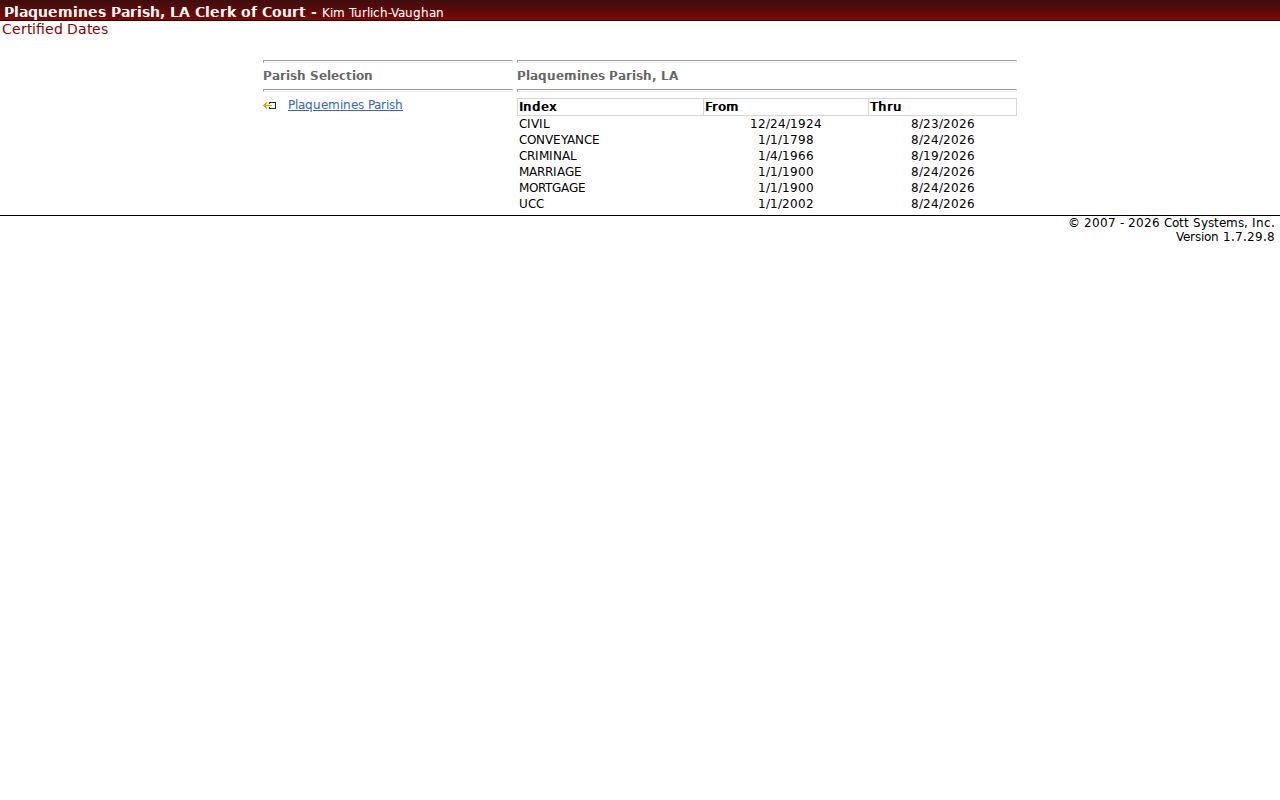
Those ranges explain a common snag. An old record may still need an archive or clerk-counter search even when a general online index exists.
Case Search Results Explained
Plaquemines uses several overlapping local terms. The clerk's fee material says docket ledger. The local rules say docket book and record jacket. Cott says docket information and docket history. One parish case record can tie together a docket number, Division A or B, a case style or parties, a filing or allotment date, chronological entries, settings, a judgment or disposition, and copy or certification references. Guest access, though, may reveal only a thin index.
| Docket number | The clerk-assigned identifier used to retrieve or request the record. Its local format was not published for guest use. |
|---|---|
| Division | The A or B court assignment recorded in the docket book or record jacket. |
| Release status | Released records have been recorded, indexed, verified, and released for public viewing; In Progress can mean verification or release is incomplete. |
| Minute entry | The clerk's concise record of court action and orders. |
| Disposition | The case or charge result, such as dismissal, judgment, conviction, or acquittal. |
Online data is a convenience copy. The clerk states that the official public records are the records in the Clerk's office.
Plaquemines Parish Docket Search Access
Guest access and paid docket access are not the same product. The Cott page lets a guest search indices at no charge. Civil and criminal docket information and images sit outside guest access. Named subscribers choose civil, criminal, or combined access. The subscription table lists a 24-hour combined plan at $20 and a 30-day combined plan at $75. Annual options appear too. Images carry a $0.50 per-page image charge. Those are portal prices, not clerk copy fees, so confirm before you buy.
Criminal images carry a second limit. Criminal index coverage starts in 1966. But criminal images only begin September 6, 2006, and early years are still coming. A missing image can mean an access, release, digitization, or date-range problem. It is not proof that no case exists.
Two Ways to Search: County and State
Louisiana offers no single unified statewide portal for searching trial-court dockets. The parish fills that gap. For a 25th JDC matter, Plaquemines Cott eSearch is the county-level tool. The Plaquemines Parish Clerk of Court holds the same records. The Louisiana Supreme Court maintains a statewide judiciary hub. That hub is not a substitute for unified trial-court docket access. Treat it as a directory, not a search tool. A justice-of-the-peace matter may instead sit in its ward court rather than the 25th JDC.
| Route | Best use | Limit |
|---|---|---|
| Plaquemines Cott eSearch | Local index research and subscribed civil or criminal docket history | Guest access excludes civil and criminal docket history and images |
| Plaquemines Parish Clerk of Court | Official record inspection, copies, certification, and older-record fallback | Access may be limited for sealed or juvenile records |
| 25th JDC public calendar | Division and setting-category context | No public name, case-number, or document search |
| Louisiana judiciary hub | State court system information | No unified public trial-court portal for Plaquemines cases |
Court dates can be cross-checked on the Plaquemines Parish Court Schedule, which covers settings across the parish. The calendar alone cannot confirm a case-specific docket result.
Plaquemines Parish Docket Calendar Check
The 25th JDC public calendar works best after a docket search has identified the division or setting type. It can show what the court has scheduled. Public categories include arraignments, magistrates, and traffic court. A trial week and motions appear too. The calendar is not a second search database. It offers no case-number search, no party search, and no document viewer. Compare any calendar event with the newest docket history. A minute entry, signed order, or direct confirmation from the division can settle what actually applies to a case. The clerk's Cott history is case-specific. It shows full detail only at the proper access level. A division-level event explains the court's schedule, but it does not prove the date, time, or location for one case.
Plaquemines Parish Docket Search Status
Cott marks each record released or In Progress. The portal's own explanation says a released item has been recorded, indexed, verified, and opened to public viewing. In Progress means it may not yet be verified or released. An official number can still exist. That label marks access status only. It is not a decision on the merits of a case. Check the index dates first. Check your account access too. Then ask whether the item is newly filed, unindexed, unreleased, missing a scanned image, restricted, or held in an older physical file. The clerk's counter or public-record custodian is the next channel when the question will not resolve online.
Plaquemines Parish Docket Search Counter
The Plaquemines Parish Clerk of Court keeps the legal record and docket ledger for the 25th JDC. Its public-access notice invites inspection without an appointment. Civil, criminal, traffic, marriage, mortgage, and conveyance records can all be examined during published business hours, with free inspection and charges for copies. The civil department can be reached directly. Its numbers are (504) 934-6617 and (504) 934-6613. The criminal department lists (504) 934-6615 and (504) 934-6619. For the general clerk, call (504) 934-6610. Older or unindexed records need detail. Bring the known number, case style, record type, division, and date, and say whether you need plain, conformed, certified, or minute-entry material. Requests for such records go to the chief deputy public-records custodian at fborne@clerk25th.com. Louisiana Code of Civil Procedure article 251 names the clerk as custodian and supports public examination and copies subject to lawful restrictions.
Plaquemines Parish Docket Filing Split
COTTFile and Cott eSearch are different tools. COTTFile is the clerk's civil and criminal e-filing vendor. Tybera is scheduled to end on June 30, 2026. Fax filing ended January 1, 2026, and attorneys must now file electronically or on paper in person. COTTFile handles filing acceptance, image display, and email notification for the filing workflow. It is not the free public docket-search portal. Keeping that split straight prevents a common mistake. Someone hunting a court record should use Cott eSearch, the clerk, or the court's calendar, while a filer should follow the clerk's e-filing instructions. Either way, the official public record stays with the clerk.
Plaquemines Parish Docket Search Federal Cases
A federal case does not belong to the 25th JDC. Plaquemines Parish sits in the Eastern District of Louisiana. There, federal records run through PACER and filings use CM/ECF. Registration is free, but official access pricing applies. The current page lists $0.10 per page. It also shows a $3 cap for a case-specific document or docket report, and a quarterly fee waiver when charges are $30 or less. A scheduled change begins January 1, 2027. PACER's official pricing information spells out those charges and the coming change.
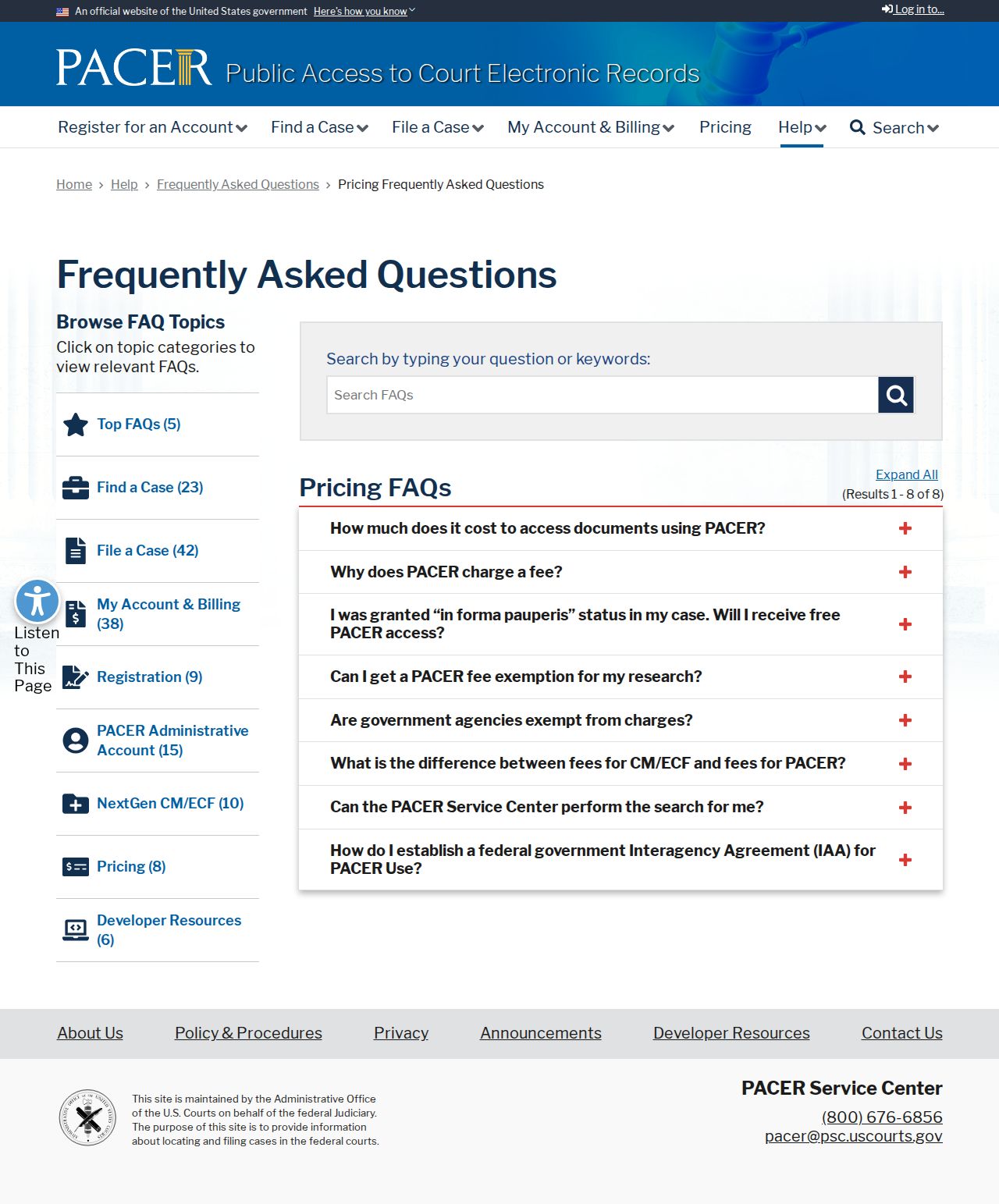
That federal fee schedule belongs to a separate system. It adds no extra layer for searching the Parish Clerk's 25th JDC docket ledger.
Which Cases Stay Restricted
Juvenile, FINS, sealed, and expunged matters do not follow the ordinary public search path. Louisiana Children's Code article 412 makes juvenile records and reports confidential, subject to statutory exceptions. The clerk says anyone seeking juvenile criminal or other sealed records must petition the court for access. A missing guest result can mean restricted, not absent. Expungement removes a qualifying record from public view without destroying it. Authorized criminal-justice agencies may still reach it. When Cott returns nothing, check the other causes first. The item may fall outside the displayed date range, sit as an In Progress record, hit an index-only guest limit, or be an unscanned older file. Protected material needs the court-authorized route. Repeated online searching will not unlock it.