
Plaquemines Parish Civil Docket Searches
Start with the Clerk of Court’s Cott eSearch portal. The guest option costs nothing. It covers index research only, though. The portal bars civil docket information and images from guest view. For the civil docket history and the civil application itself, a named subscription is the online route. Plaquemines Parish has no single statewide public trial-court case-search portal, so the clerk’s own portal and its civil department come first.
Bring the case number and division. Pull them from a petition, a service document, a prior order, or a judgment. The guest screen never shows the full civil search form. Nor does it show the field formats it accepts. Rather than guessing at a party-name, case-number, or date pattern, ask the civil department. The court has never published those patterns. The clerk’s counter works too.
- Open Plaquemines Cott eSearch and review the Certified Dates display for civil index coverage.
- Use the free guest route for index research, or a named account when civil docket history or images are needed.
- Match the case number and division against the available court document or clerk result.
- Read events in order, distinguishing a filed pleading from a later order or judgment.
- Request inspection, a copy, a minute entry, or certification from the Clerk when the official record is required.
Plaquemines Parish Civil Docket Index Limits
Cott’s two-tier access shapes any civil search you run. A guest sees the indices for free. But civil docket information and images stay locked. The index alone can mislead in both directions. Civil index coverage reaches back to December 24, 1924, yet an old file may still lack an online image. Its age, release status, account level, or a restriction may be the reason. The portal also warns that what appears online is not the official public record. Keep those limits in mind and two errors disappear: reading a free index as a whole case history, or reading a missing image as proof that nothing exists. An entry marked “In Progress” may not yet be verified. It may not be released yet. When an image refuses to load, the clerk can tell you whether a counter or archival search is the answer. The office can be reached through its contact page.
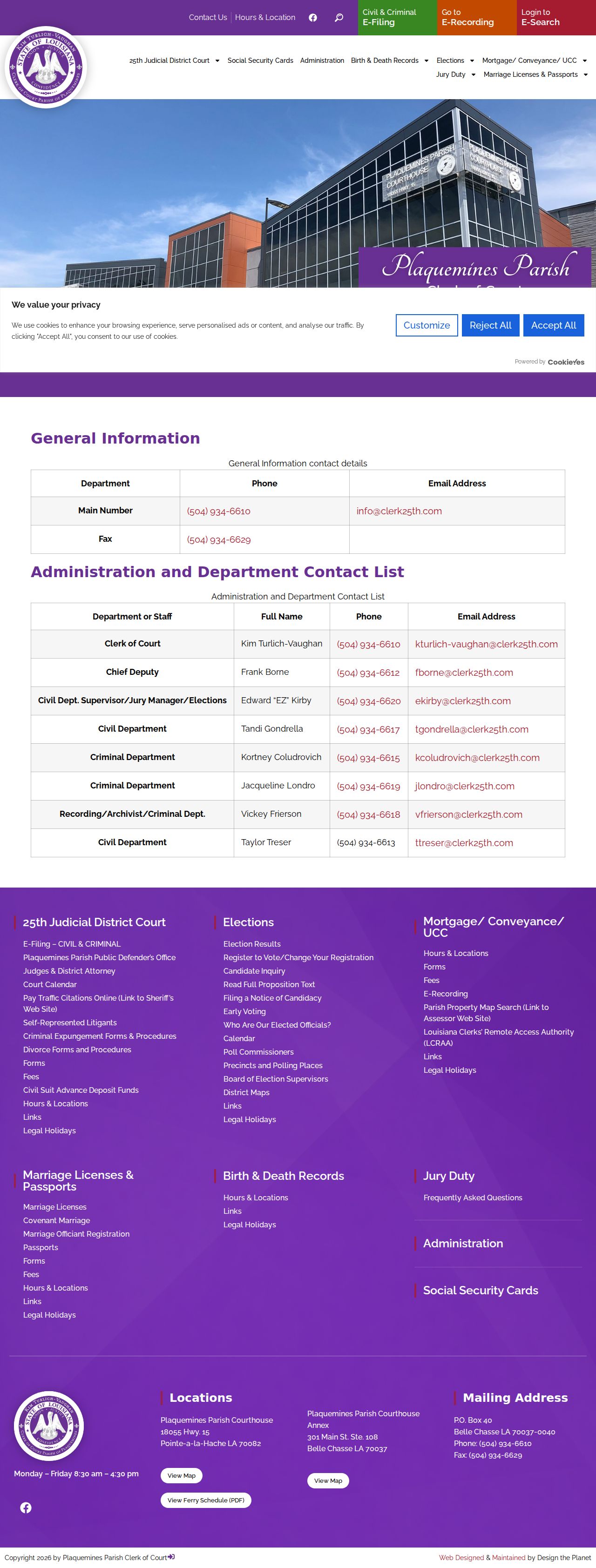
Need a human? The civil department answers at (504) 934-6617 and (504) 934-6613, with a civil supervisor and jury-manager line at (504) 934-6620. Calls move faster when you have the case number, division, and the document or date ready, plus the copy type you want: plain, conformed, certified, or a minute entry.
Civil Dockets: What They Show
Different offices use different names for the same book. The Clerk says docket ledger, while the local rules say docket book and record jacket. Whatever the label, the civil record carries a lot. It typically holds the case number, division, case style and parties, the filing or allotment date, pleadings, service, motions, orders, settings, pretrial activity, judgment, and anything filed later. Read a docket line with care. A line showing a pleading was filed says nothing about whether the court granted it. Only an order, judgment, or minute entry shows the court’s action.
| Case Number | The clerk-assigned docket number. Plaquemines does not publish a guest-readable local pattern, so use the exact number on a court document rather than a made-up YYYY-CV-##### format. |
|---|---|
| Parties and Style | The caption identifies the parties; civil pleadings may use plaintiff, defendant, petitioner, or respondent. |
| Allotment and Division | The Division A or B assignment recorded on the record jacket and docket book, including any later transfer. |
| Filings and Motions | Pleadings, service or citation, motions, rules, orders, and pretrial material in chronological order. |
| Judgment or Disposition | The formal court result, such as judgment entered, dismissal, default judgment, settlement notation, or another order; ask for the exact minute when the result matters. |
Plaquemines Parish Civil Docket Allotment
One local quirk is worth learning before you read a division label. Under the 25th JDC rules, a civil case filed before 10:00 a.m. Monday through Friday goes to a division by random drawing. The Clerk or a designee runs it. That assignment gets written on the record jacket and docket book. A division entry therefore records the allotment process, not the merits. It never replaces reading the full case history. Cases also move. A civil matter can transfer by order. The reasons include recusal, docket balance, an emergency, or another stated reason. Cases are sometimes consolidated for trial. The higher docket number then lands in the division of the lower-numbered case. So a division appearing late in a docket may simply mark administration. It may not be a brand-new civil filing. The clerk’s forms index is part of the same office.
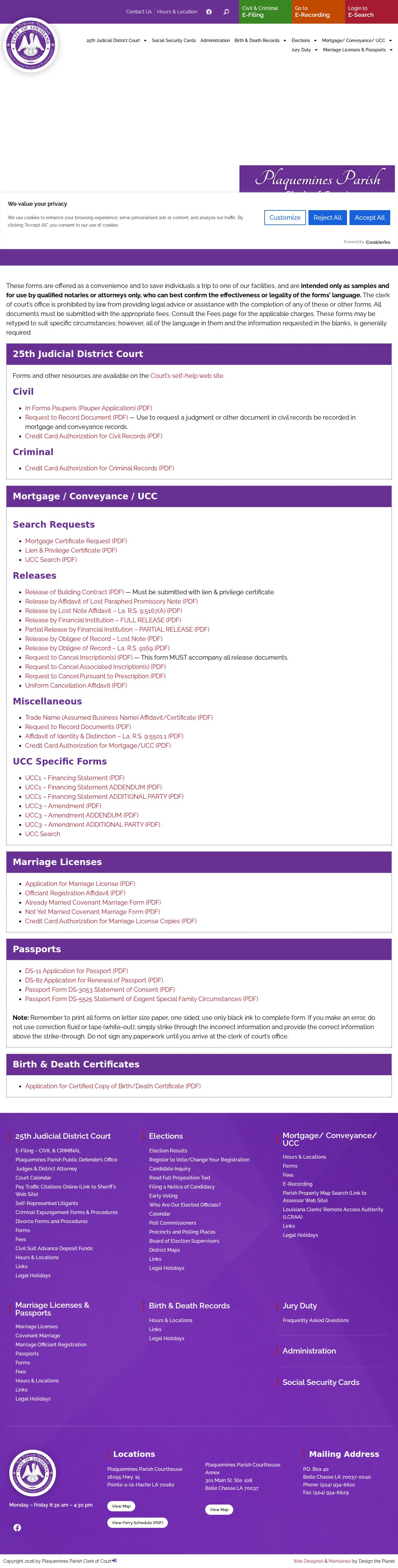
Forms are a way to make a request or file a paper. They are not proof that a docket event happened. The clerk warns that its convenience forms give no legal advice, so confirm the right document and the fee with the office before relying on one.
What Cases Fill the Civil Docket
What lands on the 25th JDC civil docket in Plaquemines Parish? Expect nearly every kind of civil and domestic work. That is what the court’s public materials point to. Expect an ordinary civil dispute, a domestic or family proceeding, a divorce, a child-support matter, civil motions, pretrial settings, a jury or bench trial, protective-order-related filings, and later judgment activity. The forum still matters, though. Justice-of-the-peace dockets are separate limited-jurisdiction records. A small local case may never appear in the 25th JDC civil history at all.
- Civil pleadings, service, motions, rules, and court orders.
- Domestic and family matters, including divorce and child-support settings.
- Civil pretrials and contested matters moving toward a bench or jury trial.
- Protective-order-related court materials handled through the appropriate court procedure.
- Judgments, dismissals, settlements or compromises, transfers, consolidations, and post-judgment filings.
Treat these categories as plain language, not a published code list. The 25th JDC posts no complete civil abbreviation dictionary. When shorthand is unclear, the full entry and the current minute entry govern over any guessed meaning.
Plaquemines Parish Civil Docket Copies
Know what you are asking for before you order. A Plaquemines Parish civil docket is only the running list of filings and court events. The petition, answer, or judgment behind each line is the document itself. A certified copy is different. The clerk issues it under the court seal, which no download, plain photocopy, or conformed copy can match. An authorized subscriber can pull a convenience image from the clerk's portal. But that image is not the official record.
The fee schedule is simple. Plain copies run $1 per page. A conformed copy costs $3, and a civil minute entry costs $5. Certification adds another $5 on top of the copy cost. Filing fees and advanced costs are billed separately from record-copy charges. When you send a request, state the format you want. Then ask the Clerk to confirm current fees and whether a docket ledger or judgment gets billed as pages, a minute entry, or both. Clerk public-records access information spells out the request process.
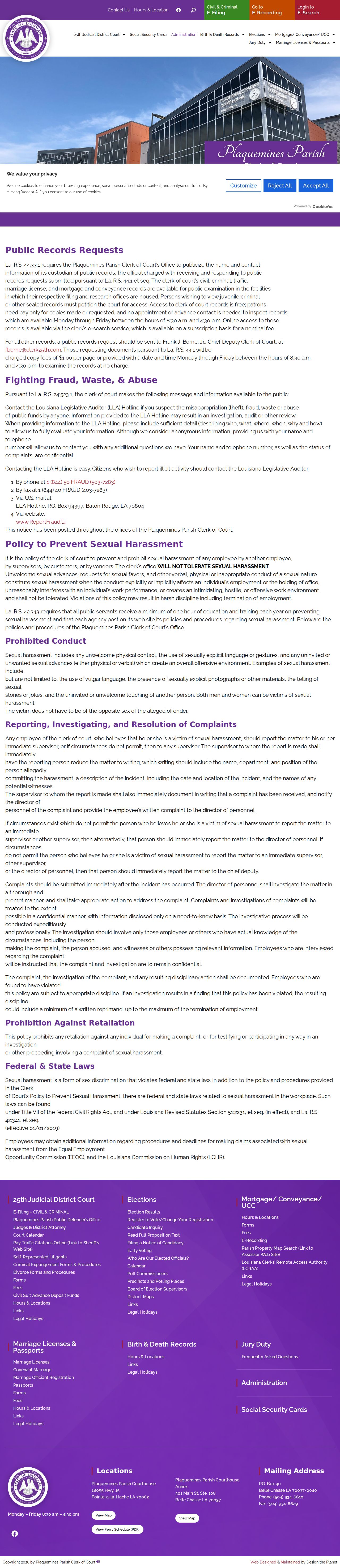
Prefer to work at the counter? The clerk allows civil records to be examined without an appointment during its published hours, and inspection itself is free. Charges kick in only when you ask for copies. That makes the counter the best fallback when guest access stops at the index or an image simply is not available online.
Plaquemines Parish Civil Record Images
The civil index reaches back to 1924. That is a genuine asset for Plaquemines Parish court records. Reach, though, is not the same as a promise. Not every historical filing can be opened as an online image. The clerk's digital system is an access layer sitting on top of a much longer paper history. An image may be missing because it has not been released, because your account lacks access, because the document is sealed or redacted, or because the older file needs an archival or counter search.
Work in order. Start with the Civil Certified Dates display and the record's release status. Then hand the Clerk the case number, the division, an approximate date, and the name of the document you want. A free review may be enough. In that case, ask about inspection. If you need the actual court document, request the right copy type. The docket index tells you where to ask. It is not the document itself.
Hearings on the Civil Docket
A civil docket history can carry a lot of moving parts: notice of setting, a motion or rule, a pretrial conference, a trial date, an order, and a later reset or continuance. For division-level context, the public 25th JDC calendar is worth a look, since it lists civil motions, civil pretrials, civil jury and bench trial weeks, family matters, and other categories. Just know its limits. It is not a case-specific search tool. An all-day event may appear with no case number or party attached.
Always confirm the current setting from the newest docket entry, a signed order, a minute entry, or direct confirmation from the division. A calendar event describes the type of court activity scheduled that week. It cannot override a later individual setting. A civil pretrial order can fix the trial date along with discovery and motion deadlines. Earlier notices go stale. The parish Court Schedule explains settings and confirmation routes in more depth.
Plaquemines Parish Civil Docket Jury Dates
Division B publishes an unusually specific civil scheduling rule. Under it, the online jury-trial selection path opens only when all parties consent. Discovery can be wrapped up within 30 to 45 days, and an initial pretrial conference has already occurred. Miss any of those conditions, and Judge Clement sets the date at pretrial instead. That single rule explains a common puzzle. A party holds a civil docket but no self-selected jury date.
The same public civil material lists a civil-minute-clerk help line at (504) 934-6733. Check the newest court entry first. Then use that division channel for a current civil setting. It does not replace the clerk's custody of the record or the official case history. Clerk COTTFile e-filing transition notice covers the change.
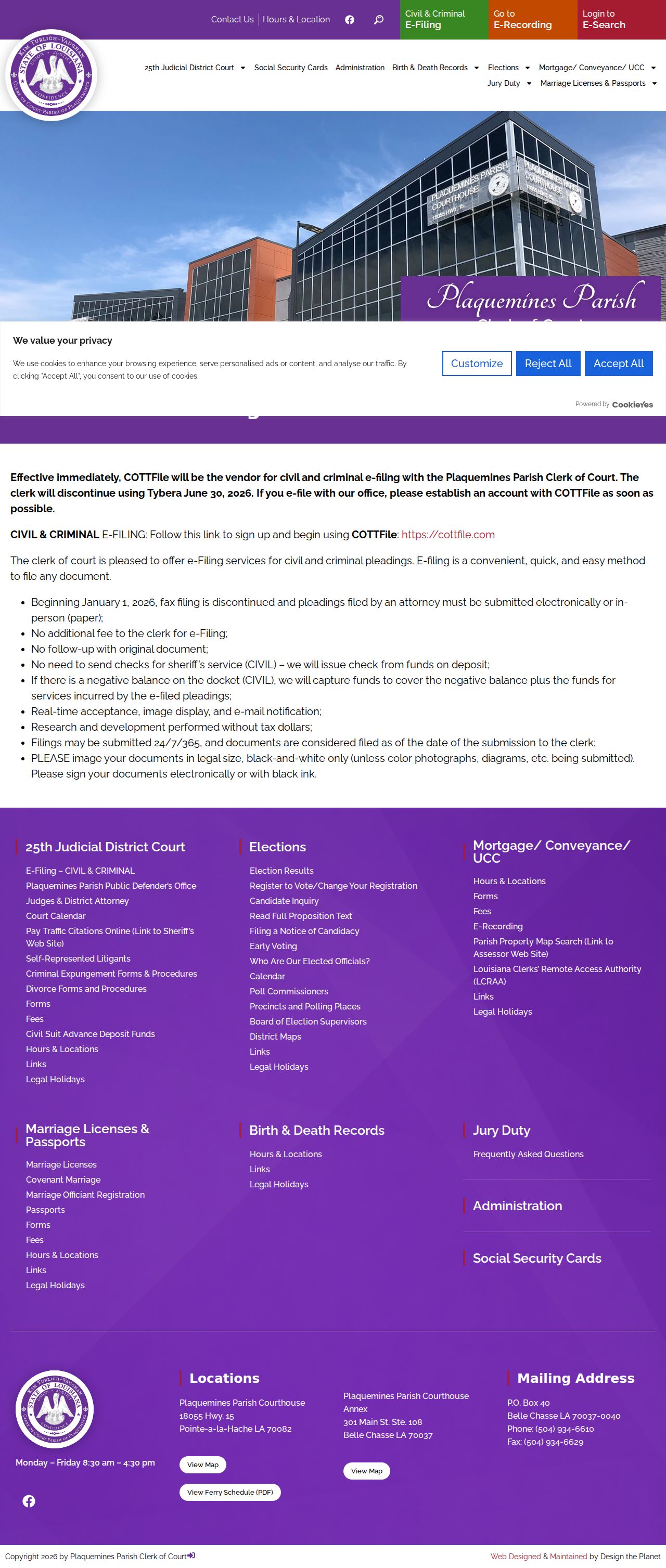
E-filing in Plaquemines Parish changed hands after the clerk's announced June 30, 2026 transition, with COTTFile replacing Tybera for civil and criminal filings, and fax filing ended January 1, 2026. COTTFile accepts filings and sends filing notifications. It is not, however, a free public civil-docket viewer. Keeping filing and search straight keeps a records question from landing in the wrong system.
Who Can See Civil Dockets
Louisiana's court-record rule names the Clerk as custodian. It generally allows public examination and copying unless a specific law or court order says otherwise. In practice, the Plaquemines Clerk lets civil records be examined without an appointment where its research offices are housed. Inspection is free. Copies carry charges. The public online portal has narrower account-based access, and it does not displace the official record the Clerk holds.
Not everything is ordinary public material, though. The clerk directs anyone seeking juvenile criminal or other sealed records to petition the court. Protected information, juvenile material, and sealed filings may be withheld, redacted, or left out of the guest view. Some items require a court-authorized process. A blank online result can also mean something mundane. It may be an unreleased record, a date-range limit, an account limitation, or an indexing delay.
Key Rules:
La. C.C.P. art. 251 - Makes the Clerk the custodian of court records and generally provides for public examination, copying, and certified copies.
La. R.S. 44:1 - Defines public records broadly, including electronic and database material held by a public body unless an exception applies.
La. R.S. 44:32 - Addresses inspection, copies, fees, and a written access determination when the custodian questions whether material is public.